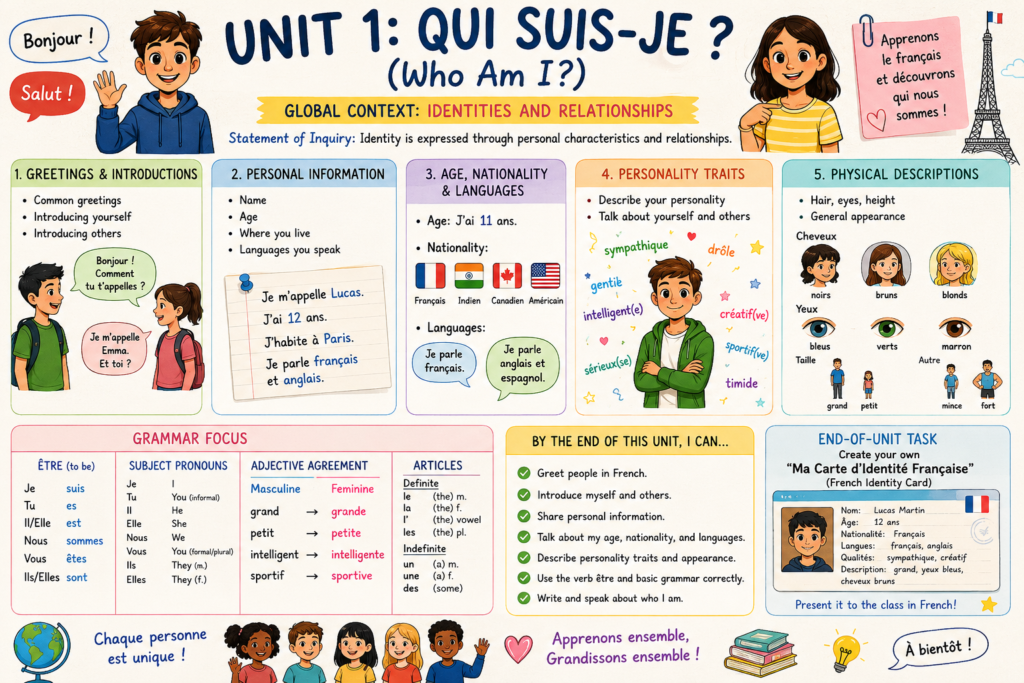
Global Context: Identities and Relationships
Statement of Inquiry
Identity is expressed through personal characteristics and relationships.
Introduction to the Unit
Bienvenue, students!
In this first unit, “Qui suis-je ?” (Who am I?), you will begin your journey of learning French by exploring your own identity. You will learn how to introduce yourself, describe your personality and appearance, talk about your age, nationality, languages, and communicate basic information about yourself.
This unit helps you understand that every person has a unique identity shaped by their personal characteristics, culture, language, and relationships with others.
By the end of this unit, you will be able to confidently introduce yourself in French and describe who you are.
Inquiry questions
Factual question
- How do we introduce ourselves in French?
- How do we describe people in French?
Conceptual question
- What makes each person unique?
Debatable question
- Is our identity determined more by our personality or by our relationships with others?
Learning objectives
By the end of this unit, you will be able to:
- Greet people appropriately in French.
- Introduce yourself and others.
- Share personal information.
- Talk about your age, nationality, and languages.
- Describe personality traits.
- Describe physical appearance.
- Use basic French grammar accurately.
- Communicate confidently in simple conversations.
Topic 1: Greetings and Introductions
(Les salutations et les présentations)
The first step in learning any language is knowing how to greet people.
Common Greetings
| French | English |
|---|---|
| Bonjour | Hello / Good morning |
| Salut | Hi |
| Bonsoir | Good evening |
| Au revoir | Goodbye |
| À bientôt | See you soon |
| À demain | See you tomorrow |
| Bonne journée | Have a good day |
Introducing Yourself
Comment tu t’appelles ?
(What is your name?)
Je m’appelle Sarah.
(My name is Sarah.)
Qui es-tu ?
(Who are you?)
Je suis Sarah.
(I am Sarah.)
Introducing others
Voici mon ami Pierre.
(This is my friend Pierre.)
Elle s’appelle Emma.
(Her name is Emma.)
Speaking activity
Work with a partner:
A: Bonjour ! Comment tu t’appelles ?
B: Je m’appelle Rohan. Et toi ?
A: Je m’appelle Maya.
B: Enchanté !
A: Enchantée !
Topic 2: Personal Information
(Informations personnelles)
You will learn how to share basic information about yourself.
Useful questions
Comment t’appelles-tu ?
What is your name?
Quel est ton âge ?
How old are you?
D’où viens-tu ?
Where are you from?
Où habites-tu ?
Where do you live?
Quelle langue parles-tu ?
What language do you speak?
Example
Bonjour !
Je m’appelle Lucas.
J’ai 11 ans.
J’habite à Paris.
Je parle français et anglais.
Writing activity
Write a short paragraph introducing yourself using:
- Name
- Age
- City
- Languages spoken
Topic 3: Age, Nationality, and Languages
(L’âge, la nationalité et les langues)
Our nationality and languages are important parts of our identity.
Talking about Age
In French, age is expressed using the verb avoir.
Examples
- J’ai 11 ans.
- Tu as 12 ans.
- Il a 13 ans.
- Elle a 12 ans.
Nationalities
Masculine Form
| French | English |
|---|---|
| Français | French |
| Indien | Indian |
| Congolais | Congolese |
| Américain | American |
| Canadien | Canadian |
Feminine Form
| French | English |
|---|---|
| Française | French |
| Indienne | Indian |
| Congolaise | Congolese |
| Américaine | American |
| Canadienne | Canadian |
Examples
Je suis Indien.
Je suis Congolais.
Elle est Française.
Ils sont Canadiens.
Languages
| French | English |
|---|---|
| le français | French |
| l’anglais | English |
| l’espagnol | Spanish |
| l’allemand | German |
| le chinois | Chinese |
Examples
Je parle français.
Je parle anglais et français.
Topic 4: Personality traits
(Les traits de personnalité)
Personality describes who we are inside.
Vocabulary
| French | English |
|---|---|
| sympathique | friendly |
| gentil | kind |
| intelligente | intelligent |
| drôle | funny |
| sérieux | serious |
| créatif | creative |
| sportif | athletic |
| timide | shy |
| patient | patient |
| courageux | brave |
Examples
Je suis sympathique.
Mon ami est drôle.
Ma sœur est intelligente.
Nous sommes créatifs.
Class activity
Interview three classmates and write:
- Their names
- One personality trait
Example:
Ananya est sympathique.
Rahul est sportif.
Sara est créative.
Topic 5: Physical descriptions
(La description physique)
Physical descriptions help us identify and describe people.
Vocabulary
Hair
| French | English |
|---|---|
| cheveux noirs | black hair |
| cheveux bruns | brown hair |
| cheveux blonds | blond hair |
| cheveux longs | long hair |
| cheveux courts | short hair |
Eyes
| French | English |
|---|---|
| yeux bleus | blue eyes |
| yeux verts | green eyes |
| yeux marron | brown eyes |
General Appearance
| French | English |
|---|---|
| grand | tall |
| petite | short |
| mince | slim |
| fort | strong |
| beau | handsome |
| belle | beautiful |
Examples
Je suis grand.
Elle a les cheveux longs.
Il a les yeux marron.
Mon ami est mince.
Grammar focus 1: Être (To Be)
The verb être is one of the most important French verbs.
Conjugation
| Subject | Être |
|---|---|
| Je | suis |
| Tu | es |
| Il/Elle | est |
| Nous | sommes |
| Vous | êtes |
| Ils/Elles | sont |
Examples
Je suis étudiant.
Tu es gentil.
Elle est intelligente.
Nous sommes amis.
Grammar focus 2: Subject pronouns
(Les pronoms sujets)
Subject pronouns replace people’s names.
| French | English |
|---|---|
| Je | I |
| Tu | You |
| Il | He |
| Elle | She |
| Nous | We |
| Vous | You (formal/plural) |
| Ils | They (masculine/mixed) |
| Elles | They (feminine) |
Examples
Marie est gentille.
Elle est gentille.
Pierre est intelligent.
Il est intelligent.
Grammar focus 3: Adjective agreement
(L’accord des adjectifs)
French adjectives must agree with the gender and number of the noun.
Masculine and Feminine
| Masculine | Feminine |
|---|---|
| petit | petite |
| grand | grande |
| intelligent | intelligente |
| sportif | sportive |
Examples
Il est intelligent.
Elle est intelligente.
Il est sportif.
Elle est sportive.
Grammar focus 4: Articles
(Les articles)
Articles come before nouns.
Definite articles
(The)
| French | English |
|---|---|
| le | the |
| la | the |
| l’ | the |
| les | the |
Examples:
- le garçon
- la fille
- l’école
- les amis
Indefinite articles
(A / An / Some)
| French | English |
|---|---|
| un | a |
| une | a |
| des | some |
Examples:
- un garçon
- une fille
- des élèves
ATL skills developed
Communication skills
- Speaking confidently
- Listening actively
- Asking and answering questions
Social skills
- Working with classmates
- Respecting different identities and cultures
Self-Management skills
- Organizing vocabulary notes
- Practising pronunciation regularly
Formative assessment
Speaking
Introduce yourself to the class in French.
Writing
Write a paragraph titled:
“Qui suis-je ?”
Include:
- Name
- Age
- Nationality
- Languages
- Personality traits
- Physical description
Reading
Read a short profile and answer comprehension questions.
Listening
Listen to students introducing themselves and complete an information chart.
Success criteria
I can:
- Greet people in French.
- Introduce myself and others.
- Share personal information.
- Talk about my age and nationality.
- Describe personality and appearance.
- Use the verb être correctly.
- Use subject pronouns and adjectives accurately.
- Write a simple self-introduction in French.
End-of-Unit Task
Create a “My French Identity Card” (Ma Carte d’Identité Française).
Include:
- Name
- Age
- Nationality
- Languages
- Personality traits
- Physical description
- A photo or drawing
Present your identity card orally to the class using complete French sentences.