What this unit is really about
This is not just a “travel” unit.
You are learning how to:
- express yourself clearly in French
- justify your ideas (this is crucial for IB)
- connect language with real-world issues (environment, culture, identity)
By the end of this unit, you should not just say:
Je voyage.
You should be able to say:
Je voyage pour découvrir d’autres cultures parce que cela m’aide à comprendre le monde.
That is the difference between basic French and IB-level communication.
Your Targets
By the end of these lessons, you should be able to:
Speak
- Describe what you see without hesitation
- Give your opinion and explain why
- Interact naturally with a partner
Write
- Describe a past trip using correct tenses
- Organize ideas using connectors
Think (IB Skills)
- Reflect on travel, culture, and environment
- Answer open questions without memorizing
Lesson 1 – Observe → Think → Speak
Starter (10 min) – Train your brain to think in French
Look at the suitcase image.
I don’t want one-word answers only. Push yourself.
Instead of:
un avion
Say:
Je vois un avion qui représente le voyage.
Your goal is to move from words → sentences → ideas.
Activity 1 – Observation (15 min)
You will:
- Write as many items as possible
Do not stop at 5–6 words. Aim for at least 15.
Then:
- Compare with a partner
- Add missing words
This matters because in IB speaking, you must expand your answers.
Activity 2 – Memory Challenge (10 min)
Close the image.
Now recall what you saw.
Say full sentences:
Je me souviens d’un appareil photo et d’un hôtel.
This builds recall speed and confidence.
Activity 3 – Speaking (20 min)
Question:
À votre avis, les vacances, c’est pour… ?
Students discuss:
- s’évader
- se reposer
- se faire des amis
- découvrir
You must go beyond simple answers.
Do not say:
Se reposer.
Say:
Je pense que les vacances sont importantes pour se reposer parce que la vie quotidienne est stressante.
You are expected to use:
- Je pense que…
- À mon avis…
- Parce que…
Push yourself to give reasons and examples.
Exit Ticket (5 min)
Write:
Pour moi, les vacances, c’est…
Minimum two sentences. No one-line answers.
Lesson 2 – Language = Power
This is where you move from basic speaker → IB student.
Do not memorize randomly.
Organize your vocabulary into themes and USE it in sentences.
1. Expériences – Vacances
Les activités (Activities)
- faire du tourisme → to go sightseeing
- visiter des monuments → to visit monuments
- se promener → to walk / to stroll
- prendre des photos → to take photos
- faire du shopping → to go shopping
- aller à la plage → to go to the beach
- faire de la randonnée → to go hiking
- nager → to swim
- explorer la ville → to explore the city
Les coutumes et traditions locales (Local customs and traditions)
- goûter la cuisine locale → to taste local food
- participer à une fête traditionnelle → to take part in a traditional festival
- découvrir la culture → to discover the culture
- parler avec les habitants → to talk with locals
- respecter les traditions → to respect traditions
L’hébergement (Accommodation)
- un hôtel → a hotel
- une auberge de jeunesse → a youth hostel
- un camping → a campsite
- un appartement → an apartment
- réserver une chambre → to book a room
- passer la nuit → to spend the night
- le confort → comfort
- le prix → price
2. Partage de la planète
Le climat et le temps (Climate and weather)
- il fait chaud → it is hot
- il fait froid → it is cold
- il pleut → it is raining
- il y a du vent → it is windy
- le soleil brille → the sun is shining
- un climat tropical / sec / humide → a tropical / dry / humid climate
L’environnement (Environment)
- la pollution → pollution
- protéger la planète → to protect the planet
- recycler → to recycle
- réduire les déchets → to reduce waste
- préserver la nature → to preserve nature
- les ressources naturelles → natural resources
L’écotourisme (Ecotourism)
- voyager de manière responsable → to travel responsibly
- respecter l’environnement → to respect the environment
- protéger les animaux → to protect animals
- éviter le plastique → to avoid plastic
- utiliser les transports écologiques → to use eco-friendly transport
3. Ingéniosité humaine
Les moyens de transport (Means of transport)
- l’avion → plane
- le train → train
- le métro → metro / subway
- le bus → bus
- le vélo → bicycle
- la voiture → car
- voyager en… → to travel by…
- prendre le train / l’avion → to take the train / plane
- arriver → to arrive
- partir → to leave
Les voyages (Travel)
- organiser un voyage → to organize a trip
- réserver un billet → to book a ticket
- faire ses valises → to pack your bags
- partir en vacances → to go on holiday
- revenir de vacances → to come back from holiday
- visiter un pays → to visit a country
Les explorateurs (Explorers)
- découvrir de nouveaux endroits → to discover new places
- explorer une région → to explore a region
- un voyageur / une voyageuse → a traveler
- une aventure → an adventure
- un guide touristique → a tour guide
4. Expressions utiles
Donner son opinion (Giving opinion)
- Je pense que… → I think that…
- À mon avis… → In my opinion…
- Je crois que… → I believe that…
Justifier (Giving reasons)
- parce que… → because…
- car… → because / since…
- en effet… → indeed…
Donner un exemple (Giving an example)
- par exemple… → for example…
- comme… → like / such as…
Organiser (Structuring ideas)
- d’abord… → first…
- ensuite… → then…
- puis… → then / next…
- enfin… → finally…
Sentences
Example 1:
Je vais à la plage pour me reposer.
→ I go to the beach to relax.
Example 2:
Je vais à la plage pour me reposer parce que la vie quotidienne est stressante.
→ I go to the beach to relax because daily life is stressful.
Example 3:
D’abord, je suis arrivé à l’hôtel. Ensuite, j’ai visité la ville.
→ First, I arrived at the hotel. Then, I visited the city.
Advice
If you want to improve fast:
- Learn vocabulary in categories, not lists
- Always make full sentences
- Always add because (parce que)
Practice
Complete:
- Pendant mes vacances, je…
- J’aime voyager parce que…
- D’abord…, ensuite…, enfin…
- À mon avis, l’écotourisme est important parce que…
Grammar 1 – Passé composé
You already know:
Passé composé = actions in the past
Now we go deeper. This is where many of you lose marks, so we fix that.
1. FORM – Two auxiliaries
The passé composé is formed with:
Subject + auxiliary (avoir or être) + past participle
A. Auxiliaire: AVOIR (MOST verbs)
About 90% of verbs use avoir
Structure
Subject + avoir (present) + past participle
Past participle formation
-ER verbs → é
- parler → parlé
- visiter → visité
-IR verbs → i
- finir → fini
- choisir → choisi
-RE verbs → u
- vendre → vendu
- attendre → attendu
Common irregular past participles
You MUST memorize these:
- avoir → eu
- être → été
- faire → fait
- prendre → pris
- mettre → mis
- dire → dit
- écrire → écrit
- voir → vu
- boire → bu
- pouvoir → pu
- vouloir → voulu
- devoir → dû
Examples (AVOIR)
- J’ai mangé.
- J’ai visité Paris.
- J’ai vu un monument.
Agreement rule (VERY IMPORTANT)
With avoir:
NO agreement with the subject
J’ai allée
J’ai allé (but actually → je suis allé, because “aller” uses être)
Only exception:
Agreement with direct object before the verb (not needed for now at Ab Initio)
B. Auxiliaire: ÊTRE (Movement + Reflexive verbs)
A small group of verbs use être
These are often called:
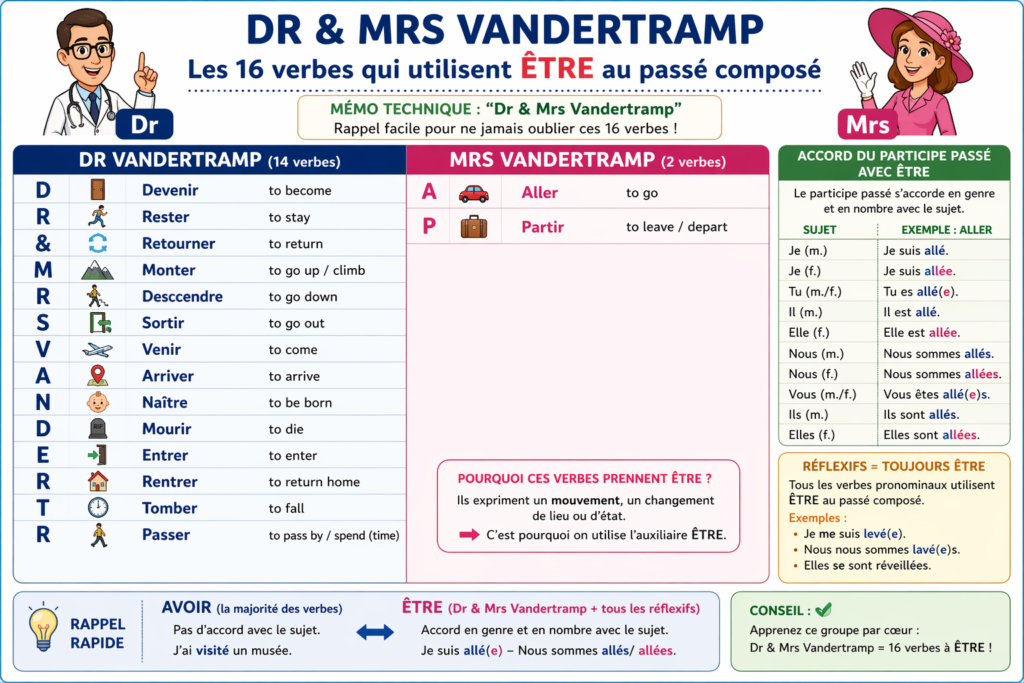
“Dr & Mrs Vandertramp” (16 verbs)
The 16 ÊTRE verbs (movement/change of state)
- aller (to go)
- venir (to come)
- arriver (to arrive)
- partir (to leave)
- entrer (to enter)
- sortir (to go out)
- monter (to go up)
- descendre (to go down)
- naître (to be born)
- mourir (to die)
- rester (to stay)
- retourner (to return)
- tomber (to fall)
- passer (to pass)
- rentrer (to return home)
- devenir (to become)
Structure (ÊTRE)
Subject + être (present) + past participle
Examples:
- Je suis allé
- Elle est arrivée
- Nous sommes partis
AGREEMENT
With être, the past participle AGREES with the subject:
| Subject | Example |
|---|---|
| Masculine singular | Je suis allé |
| Feminine singular | Je suis allée |
| Masculine plural | Nous sommes allés |
| Feminine plural | Nous sommes allées |
Examples
- Elle est allée à Paris.
- Ils sont arrivés tôt.
- Elles sont parties hier.
Reflexive verbs (IMPORTANT)
All reflexive verbs use être
Examples:
- se lever → je me suis levé(e)
- se réveiller → je me suis réveillé(e)
- se coucher → je me suis couché(e)
2. USAGE (When to use Passé composé)
Use it for:
- completed actions
- specific events
- actions in sequence
Examples:
- J’ai visité la ville.
- Je suis allé à l’hôtel.
3. WHY
If you misuse:
- auxiliaries (avoir vs être)
- agreements
You lose marks in:
- accuracy
- grammar range
IB expects:
- correct auxiliary
- correct past participle
- correct agreement (for être verbs)
4. WHEN (How to choose avoir vs être)
Ask yourself:
Is it a movement/change verb?
→ use être
Is it most other verbs?
→ use avoir
Quick examples:
- visiter → avoir → j’ai visité
- aller → être → je suis allé
5. COMMON MISTAKES
Incorrect: J’ai allé
Correct: Je suis allé
Incorrect: Elle a arrivée
Correct: Elle est arrivée
Incorrect: Je suis allé (female speaker)
Correct: Je suis allée
6. Sentence model
Je suis allé à Paris et j’ai visité plusieurs monuments parce que j’aime découvrir de nouvelles cultures.
This includes:
- être verb (aller)
- avoir verb (visiter)
- reason (parce que)
Final advice
If you want to improve quickly:
- Learn verb groups (-ER, -IR, -RE)
- Memorize key irregular verbs
- Master the 16 être verbs
- Always check agreement
Golden Rule
Before speaking or writing, ask:
- Which auxiliary? (avoir ou être)
- Do I need agreement?
- Is the past participle correct?
Grammar 2 – Connectors (Les connecteurs logiques)
1. FORM – What are connectors?
Connectors are linking words that:
- connect ideas
- organize your speech
- make your answer logical
They are usually:
- adverbs (d’abord, ensuite…)
- conjunctions (donc, parce que…)
2. CORE CONNECTORS YOU MUST USE
To organize a sequence (chronological order)
- d’abord → first
- ensuite → then
- puis → next
- enfin → finally
These help you tell a story step by step.
To show result
- donc → therefore / so
This shows cause → consequence
3. USAGE – How to use them correctly
Position in a sentence
Most connectors come:
at the beginning of the sentence
Examples:
- D’abord, je suis arrivé à Paris.
- Ensuite, j’ai visité un musée.
- Enfin, j’ai mangé dans un restaurant.
Using “donc” (result)
“Donc” usually comes:
in the middle of a sentence
Example:
- Il faisait beau, donc j’ai visité la ville.
4. WHY (Why connectors are essential in IB)
Without connectors:
– Your answer sounds like a list
– No flow, no structure
– Lower marks in communication
Example (weak):
Je suis arrivé. J’ai mangé. J’ai visité.
With connectors:
– Clear structure
– Logical progression
– Higher IB marks
Example (strong):
D’abord, je suis arrivé. Ensuite, j’ai mangé. Enfin, j’ai visité la ville.
5. WHEN to use connectors
You must use connectors in:
Speaking
- describing a photo
- answering questions
- telling a story
Writing
- emails
- blog posts
- diary entries
Rule:
Use at least 2–3 connectors in every answer
6. Building IB-LEVEL answers
Step-by-step model:
- Start → d’abord
- Continue → ensuite / puis
- End → enfin
- Add result → donc
Example (basic → advanced)
Basic:
Je suis allé à Paris.
Better:
D’abord, je suis allé à Paris.
Strong:
D’abord, je suis allé à Paris. Ensuite, j’ai visité un musée. Enfin, j’ai mangé dans un restaurant.
IB Level:
D’abord, je suis allé à Paris. Ensuite, j’ai visité un musée, donc j’ai appris beaucoup de choses. Enfin, j’ai mangé dans un restaurant.
7. Common Mistakes
Using no connectors
Repeating only “et”
Writing disconnected sentences
8. Extension
Add more connectors:
Cause
- parce que → because
- car → because
Contrast
- mais → but
Addition
- aussi → also
9. Practice
Complete:
- D’abord, je…
- Ensuite, je…
- Enfin, je…
- Il faisait beau, donc…
10. Final Model
D’abord, je suis arrivé à Paris. Ensuite, j’ai visité plusieurs monuments parce que j’aime l’histoire. Enfin, j’ai mangé dans un restaurant, donc j’étais très content.
Important
If you want to improve immediately:
- Always organize your ideas
- Always use connectors
- Never give isolated sentences
Remember:
Good French is not about difficult words.
It is about clear and logical structure.
Here is a mentor-level, clear and detailed explanation for your DP2 students on:
Grammar 3 – Plus-que-parfait
1. What is the Plus-que-parfait?
The plus-que-parfait is a past tense used to talk about:
something that happened before another past action
In English, it is:
“had done”
Example:
J’avais déjà visité ce pays.
→ I had already visited this country.
2. FORM – How to build it
The structure is very logical:
Imparfait of avoir / être + past participle
A. With AVOIR (most verbs)
Imparfait of avoir:
- j’avais
- tu avais
- il/elle avait
- nous avions
- vous aviez
- ils/elles avaient
Example:
- J’avais visité Paris.
- Nous avions mangé.
B. With ÊTRE (movement + reflexive verbs)
Imparfait of être:
- j’étais
- tu étais
- il/elle était
- nous étions
- vous étiez
- ils/elles étaient
Example:
- Je suis allé → passé composé
- J’étais allé → plus-que-parfait
Agreement (same rule as passé composé)
With être, you must agree:
- Elle était allée
- Ils étaient partis
3. USAGE – When do we use it?
Use the plus-que-parfait when:
you are talking about the past
and you want to go further back in time
Timeline idea:
- Earlier past → plus-que-parfait
- Later past → passé composé
Example:
Quand je suis arrivé à Paris, j’avais déjà visité la ville.
→ I arrived (past)
→ I had already visited (earlier past)
4. WHY is it important for IB?
Using the plus-que-parfait:
- shows complex thinking
- shows time relationships
- increases your grammar range score
Without it:
– Your story is simple
With it:
– Your story is more advanced and precise
5. WHEN should YOU use it (practically)?
Use it when you want to say:
- “I had already…”
- “I had never…”
- “Before that…”
Useful expressions:
- déjà → already
- jamais → never
- avant → before
Examples:
- J’avais déjà mangé.
- Je n’avais jamais visité ce pays.
- Avant de partir, j’avais réservé un hôtel.
6. Combine with other tenses
This is your goal:
Use 3 layers of time
Example:
Quand je suis arrivé à Paris, il faisait beau et j’avais déjà visité la ville.
This includes:
- passé composé → action
- imparfait → description
- plus-que-parfait → earlier past
7. Common Mistakes
- Using present instead of past
- Forgetting auxiliary (avoir / être)
- Wrong agreement with être
8. Important Message
You do NOT need to master this perfectly now.
Focus on:
- understanding the meaning
- recognizing it in texts
- trying simple sentences
Exit task
Write 3 sentences using:
- past tense
- connectors
Model answers:
- D’abord, je suis allé à Paris et il faisait beau.
- Ensuite, j’ai visité un musée parce que j’aime l’histoire.
- Enfin, j’ai mangé dans un restaurant et j’avais déjà visité cet endroit.
Final advice
To improve quickly:
Ask yourself:
- What happened? → passé composé
- What was it like? → imparfait
- What happened before? → plus-que-parfait
This is how you move from:
basic answers → IB-level responses
Lesson 3 – Think Like an IB Student
Starter (5 min)
Question:
Pourquoi voyage-t-on ?
I do not want short answers.
Do not say:
Pour se reposer.
Say:
Je pense que les gens voyagent pour se reposer parce que la vie quotidienne est stressante.
Push yourself to:
- give an opinion
- add a reason
- extend your answer
If your answer is only one sentence, it is not enough.
TOK Discussion (15 min)
Question:
Doit-on tout explorer ?
There is no correct answer here.
What matters is:
- how you think
- how you justify your ideas
- how clearly you express yourself
You can agree or disagree—but you must explain.
How to structure your response
Use this model:
- À mon avis…
- Je pense que…
- Parce que…
- Par exemple…
Example (strong response)
À mon avis, on ne doit pas tout explorer parce que certaines régions doivent être protégées. Par exemple, l’Antarctique est fragile.
What IB expects from you
- not memorized answers
- not “yes/no” responses
- but critical thinking + justification
This is the difference between:
basic student → IB student
CAS Activity (15 min)
You are now connecting French to the real world.
Task: Create a forum idea
Topic:
Les meilleurs endroits à visiter
You will:
- share travel experiences
- recommend places
What I expect
You must include:
- 3 opinions
- 1 recommendation
Example
À mon avis, Paris est une ville magnifique parce qu’il y a beaucoup de monuments. Je recommande de visiter la tour Eiffel.
Why this matters
This is not just language practice.
You are developing:
- communication
- real-world engagement
- IB CAS mindset (Creativity, Activity, Service)
Speaking Role Play (15 min)
Situation
- Student A = Touriste
- Student B = Guide
Focus
You must:
- ask questions clearly
- answer with full sentences
- give useful information
Useful questions
- Où puis-je aller ?
- Que puis-je visiter ?
- Combien ça coûte ?
Weak vs Strong
Weak:
Va là-bas.
Strong:
Vous pouvez visiter ce musée parce qu’il est très intéressant.
Goal
Not perfection.
Communication.
Final Reflection (10 min)
Question:
La notion de voyage a-t-elle changé ?
What I expect from you
You must:
- give an opinion
- justify it
- connect ideas
Example (IB-level response)
Je pense que la notion de voyage a changé parce qu’aujourd’hui, les gens voyagent plus facilement grâce à la technologie. Par exemple, il est facile de réserver un billet en ligne.
Final Mentor Message
At this stage (DP2), you must:
- speak in full sentences
- always justify your ideas
- connect your ideas logically
Do not aim for:
perfect grammar only
Aim for:
– clear communication
– structured answers
– thoughtful ideas
Golden Rule
If your answer does not include:
- an opinion
- a reason
- an example
it is not an IB-level answer yet.
Differentiation
If you struggle
- Use sentence starters
- Speak slowly but clearly
If you are strong
- Use plus-que-parfait
- Justify every idea
- Speak longer
Homework
Choose one:
- Record a 1-minute speaking task
- Write a short travel diary
- Research eco-tourism
Final Message
If you want to succeed in IB French:
Do not aim to be perfect.
Aim to communicate clearly.
Always explain your ideas.
Simple, clear, structured answers will get you high marks.
A. Souvenirs de vacances
B. Récits de vacances
C. Faire le tour du monde, ça vous dit ?
Préparez une li
D. Voyager à travers les livres
E. Le tourisme responsable
F. Joignez l’utile à l’agréable : avez-vous déjà pensé au travail solidaire ?
G. La vie, c’est fait pour vivre des aventures !
H. Écouter et comprendre
I. À L’ÉCOUTE : FAITES VOS PREUVES !