
Description
Learn the difference between passé composé and imparfait in French with clear rules, examples, and A2 practice for TEF Canada.
Introduction: The Most Important Contrast at A2
At A2 (75%), this is one of the most important grammar skills:
understanding passé composé vs imparfait
You must be able to:
- describe a situation (imparfait)
- talk about an action (passé composé)
- combine both in one sentence
This helps you:
- tell simple stories
- speak more naturally
- improve your TEF score
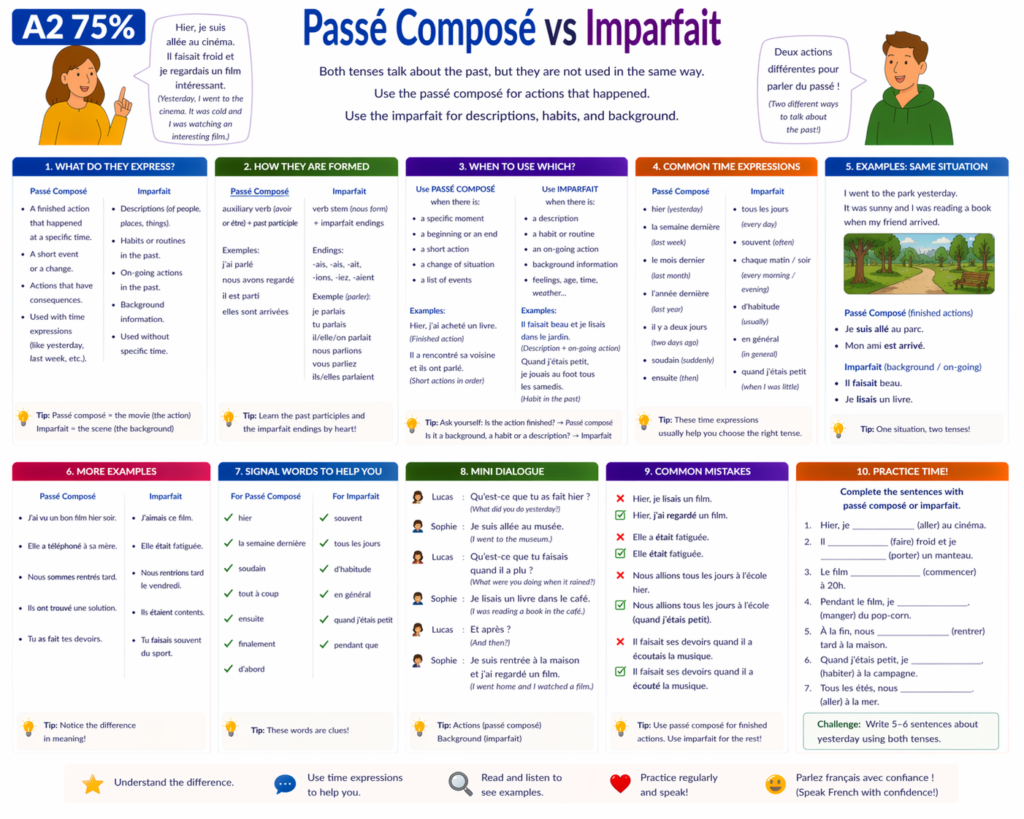
What Is the Difference?
Simple Rule
- Imparfait → description / habit
- Passé composé → action / event
Example
- Il pleuvait → It was raining (background)
- Je suis sorti → I went out (action)
One describes, one moves the story forward
1. Imparfait = Description / Background
Use imparfait for:
- habits
- repeated actions
- descriptions
- ongoing situations
Examples
- Quand j’étais jeune, je jouais dehors
- Il faisait froid
- Je regardais la télévision
Think: background
2. Passé Composé = Action / Event
Use passé composé for:
- finished actions
- one-time events
- important actions
Examples
- J’ai mangé
- Je suis allé au cinéma
- Il a appelé
Think: action
3. Using Both Together (VERY IMPORTANT)
At A2, you must combine both.
Structure
Imparfait + passé composé
Examples
- Il pleuvait quand je suis sorti
- Je regardais la télévision quand il a appelé
Imparfait = background
Passé composé = event
4. Timeline Logic (Easy to Understand)
Imagine:
- background = continuous
- action = sudden
Example
- Il faisait chaud (background)
- Je suis allé au parc (action)
5. Signal Words
Imparfait
- avant
- souvent
- tous les jours
- quand j’étais…
Passé composé
- hier
- soudain
- une fois
- tout à coup
These help you choose the tense
6. Common Mistakes
Errors
- Hier, je jouais au cinéma
- Quand j’étais jeune, j’ai joué tous les jours
Correct Forms
- Hier, je suis allé au cinéma
- Quand j’étais jeune, je jouais tous les jours
Match tense with meaning
7. A2 Level Sentences
Examples
- Quand j’étais enfant, je jouais dehors
- Hier, j’ai regardé un film
Combined
- Je regardais la télévision quand il a appelé
- Il pleuvait et je suis resté à la maison
This is A2 storytelling
8. TEF Canada Strategy
In TEF Canada, passé composé vs imparfait is used to:
- tell short stories
- describe past life
- explain events
What the examiner checks
- correct tense choice
- logical sentence
- clear meaning
High-Scoring Example
Quand j’étais jeune, je jouais dehors.
Hier, j’ai regardé un film.
Il pleuvait quand je suis sorti.
9. Practice (A2 Level)
Exercise 1
Choose:
- Quand j’étais jeune, je ______ (jouais / ai joué)
- Hier, j’______ (ai regardé / regardais) un film
Exercise 2
Complete:
- Il ______ (pleuvoir) quand je ______ (sortir)
Exercise 3
Write 2 sentences:
- one with imparfait
- one with passé composé
10. Mini TEF Speaking Task
Question
Parlez de votre journée hier
Model Answer
Hier, j’ai travaillé.
Il faisait chaud.
Je suis allé au parc.
Je regardais la télévision quand il a appelé.
Continue Learning French
After mastering passé composé vs imparfait, continue with:
FAQ
What is the difference between passé composé and imparfait?
Imparfait describes, passé composé shows action.
When do you use imparfait?
For habits and background.
When do you use passé composé?
For finished actions.
Is this important for TEF Canada?
Yes. It is essential for narration.
Final Tip
To master passé composé vs imparfait:
think background vs action
use simple sentences
combine both
This builds storytelling skills.