
Description
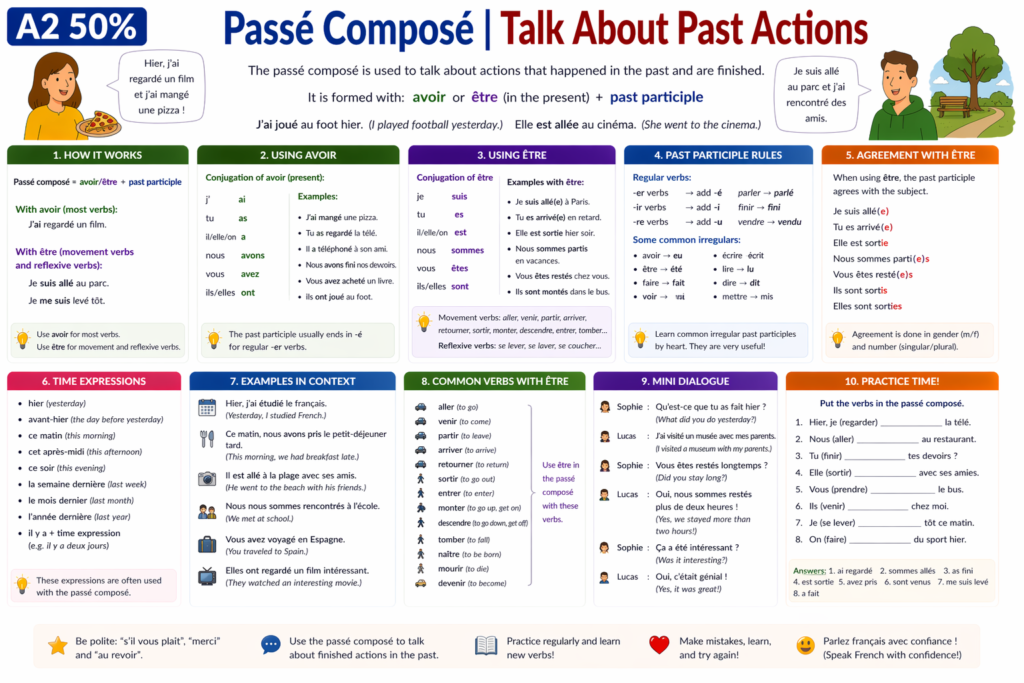
Learn the French passé composé at A2 level with avoir, être, the 16 verbs, and clear examples for TEF Canada.
Introduction: Speaking About the Past in French
At A2 (50%), you must go beyond present tense.
You must talk about:
- what you did
- where you went
- what happened
This is done using:
French passé composé A2
Mastering this will help you:
- describe past actions
- answer TEF questions
- sound more natural
What Is the Passé Composé?
The passé composé is used for:
finished actions in the past
Examples
- J’ai mangé → I ate
- J’ai regardé un film → I watched a film
The action is completed.
1. Structure of Passé Composé
Rule
auxiliary (avoir / être) + past participle
Examples
- J’ai mangé
- Je suis allé(e)
You must choose:
– avoir
– or être
2. Conjugation of AVOIR (VERY IMPORTANT)
You must know this perfectly.
Avoir (present)
- j’ai
- tu as
- il / elle a
- nous avons
- vous avez
- ils / elles ont
Examples
- J’ai mangé
- Nous avons travaillé
- Ils ont regardé
Most verbs use avoir.
3. Conjugation of ÊTRE (VERY IMPORTANT)
Used with movement verbs.
Être (present)
- je suis
- tu es
- il / elle est
- nous sommes
- vous êtes
- ils / elles sont
Examples
- Je suis allé(e)
- Nous sommes arrivés
- Elles sont parties
Fewer verbs use être, but they are important.
4. The 16 Verbs with ÊTRE (MUST KNOW)
These are movement or state-change verbs.
List
- aller (to go)
- venir (to come)
- arriver (to arrive)
- partir (to leave)
- entrer (to enter)
- sortir (to go out)
- monter (to go up)
- descendre (to go down)
- naître (to be born)
- mourir (to die)
- tomber (to fall)
- rester (to stay)
- passer (to pass)
- retourner (to return)
- rentrer (to go home)
- devenir (to become)
Examples
- Je suis allé(e) au marché
- Elle est arrivée
- Nous sommes partis
These verbs are very common in TEF.
5. Past Participle Formation
-ER verbs
remove -er → add é
Examples
- manger → mangé
- travailler → travaillé
- regarder → regardé
Most A2 verbs follow this rule.
6. Agreement with ÊTRE (IMPORTANT)
When using être, the past participle agrees.
Rule
agree with subject (gender + number)
Examples
- Elle est allée
- Ils sont arrivés
- Elles sont parties
Add:
- -e (feminine)
- -s (plural)
7. Using Passé Composé in Sentences
Examples
- J’ai mangé au restaurant
- J’ai pris le bus
- Je suis allé au marché
A2 Level (Connected)
- Hier, j’ai mangé au restaurant
- Ensuite, je suis allé au marché
Use time words:
– hier
– ce matin
– la semaine dernière
8. Common Mistakes in Passé Composé
Errors
- Je mangé
- Je suis mangé
- J’ai allé
Correct Forms
- J’ai mangé
- Je suis allé
Remember:
– avoir for most verbs
– être for movement verbs
9. TEF Canada Strategy (Exam Focus)
In TEF Canada, French passé composé A2 is used to:
- describe past actions
- answer questions
- show grammar control
What the examiner checks
- correct auxiliary
- correct past participle
- simple, clear sentences
High-Scoring Example
- Hier, j’ai mangé au restaurant
- Ensuite, je suis allé au marché
Simple + logical = strong answer
10. Practice (A2 Level)
Exercise 1
Complete:
- Hier, j’________ (manger) au restaurant
- Nous ________ (aller) en ville
Exercise 2
Choose correct form:
- J’ai allé (incorrect) / Je suis allé (correct)
Exercise 3
Write 3 sentences:
- one with avoir
- one with être
- one with time expression
11. Mini TEF Speaking Task
Situation: Talk about yesterday
Model Answer
Hier, j’ai mangé au restaurant.
Ensuite, je suis allé au marché.
J’ai pris le bus.
Continue Learning French
After mastering French passé composé A2, continue with:
FAQ
What is the passé composé?
A past tense for completed actions.
How is it formed?
Auxiliary (avoir/être) + past participle.
Which verbs use être?
16 movement verbs (aller, venir, etc.).
Is this important for TEF Canada?
Yes. Essential for speaking and writing.
Final Tip
To master French passé composé A2, remember:
- avoir + past participle (most verbs)
- être + agreement (16 verbs)
- use time expressions
This is your key to talking about the past.

Topics are explained properly and step by step. The explanation is on point definitely recommended.