Description
Learn French reflexive verbs (se lever, se laver, se coucher) with structure, examples, and A2 practice for TEF Canada.
Introduction: Why Reflexive Verbs Matter at A2
In this lesson on French reflexive verbs A2, you will learn how to describe your daily routine clearly and naturally.
At A2 level, you must:
- talk about your day
- describe habits
- use correct verb structure
Mastering French reflexive verbs A2 will help you:
- speak about routines
- build natural sentences
- improve your TEF Canada speaking score
What Are French Reflexive Verbs?
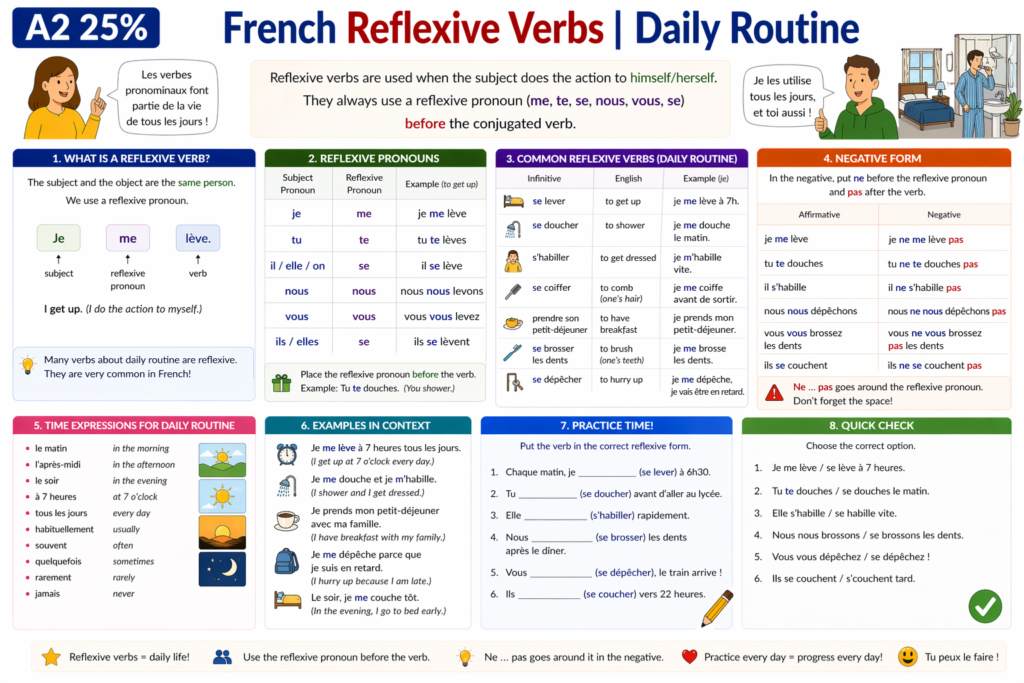
French reflexive verbs describe actions you do to yourself.
Simple Idea
The subject does the action AND receives the action
Examples
- Je me lave → I wash myself
- Je me lève → I get up
- Je me couche → I go to bed
1. Structure of Reflexive Verbs (VERY IMPORTANT)
Rule
subject + reflexive pronoun + verb
Reflexive Pronouns
- je → me / m’
- tu → te
- il / elle → se
- nous → nous
- vous → vous
- ils / elles → se
Example: se lever
- je me lève
- tu te lèves
- il se lève
- nous nous levons
- vous vous levez
- ils se lèvent
The reflexive pronoun is always BEFORE the verb.
2. Elision Rule (IMPORTANT)
Rule
me / te / se → m’ / t’ / s’ before vowel
Examples
- Je me appelle (incorrect)
- Je m’appelle (correct)
- Il se habille (incorrect)
- Il s’habille (correct)
This makes pronunciation smooth.
3. Common Reflexive Verbs (Daily Routine)
You must know these for French reflexive verbs A2:
- se lever → to get up
- se réveiller → to wake up
- se laver → to wash
- s’habiller → to get dressed
- se coucher → to go to bed
Examples
- Je me lève à 7 heures
- Je me lave
- Je me couche à 23 heures
These are essential for daily life.
4. Using Reflexive Verbs in Sentences
Basic Structure
- Je me lève à 7 heures
- Je me prépare rapidement
- Je me couche tard
A2 Level (Add details)
- Je me lève à 7 heures et je me prépare
- Je me couche tard parce que je travaille
Add connectors to improve your level.
5. Common Mistakes in Reflexive Verbs
Errors
- Je lève
- Je me lever
- Je lave
Correct Forms
- Je me lève
- Je me lave
Never forget the reflexive pronoun.
6. Reflexive Verbs vs Normal Verbs
Compare
- Je lave la voiture → I wash the car
- Je me lave → I wash myself
Meaning changes completely.
7. TEF Canada Strategy (Exam Focus)
In TEF Canada, French reflexive verbs A2 are used to:
- describe daily routine
- talk about habits
- structure speaking answers
What the examiner checks
- correct structure
- correct pronoun
- natural sentences
High-Scoring Example
- Je me lève à 7 heures
- Je me prépare rapidement
- Je me couche à 23 heures
Clear routine = strong answer
8. Practice (A2 Level)
Exercise 1
Complete:
- Je ___ lève (me / se)
- Nous ___ levons (nous / se)
Exercise 2
Correct:
- Je lève
- Je me lever
Exercise 3
Write 3 sentences:
- one morning action
- one afternoon action
- one evening action
9. Mini TEF Speaking Task
Situation: Describe your daily routine
Model Answer
Je me lève à 7 heures.
Je me prépare rapidement.
Je me couche à 23 heures.
Continue Learning French
After mastering French reflexive verbs A2, continue with:
- Learn everyday verbs (aller, venir, prendre, mettre)
- Practice modal verbs (vouloir, pouvoir, devoir)
FAQ
What are French reflexive verbs?
Verbs where the subject does the action to itself.
What is the structure?
subject + reflexive pronoun + verb.
Why are they important?
They are used for daily routine.
Is this important for TEF Canada?
Yes. Very common in speaking tasks.
Final Tip
To master French reflexive verbs A2, remember:
- always use the reflexive pronoun
- place it before the verb
- use it for daily routine
This is essential for natural French.