Description
Learn French -ER verbs with clear conjugation rules, spelling tips, pronunciation, and A2 practice for TEF Canada.
Introduction: Why -ER Verbs Are Your Foundation
In this lesson on French -ER verbs, you will strengthen the most important pattern in French.
At A2 level, your goal is:
- to use verbs automatically
- to avoid spelling mistakes
- to speak smoothly
Mastering French -ER verbs will help you:
- build correct sentences quickly
- speak with confidence
- improve your TEF Canada score
What Are French -ER Verbs?
French -ER verbs are verbs that end in -er in the infinitive.
They are:
- the most common verbs in French
- the easiest to conjugate
- essential for A2 communication
Examples
- parler → to speak
- travailler → to work
- habiter → to live
- aimer → to like
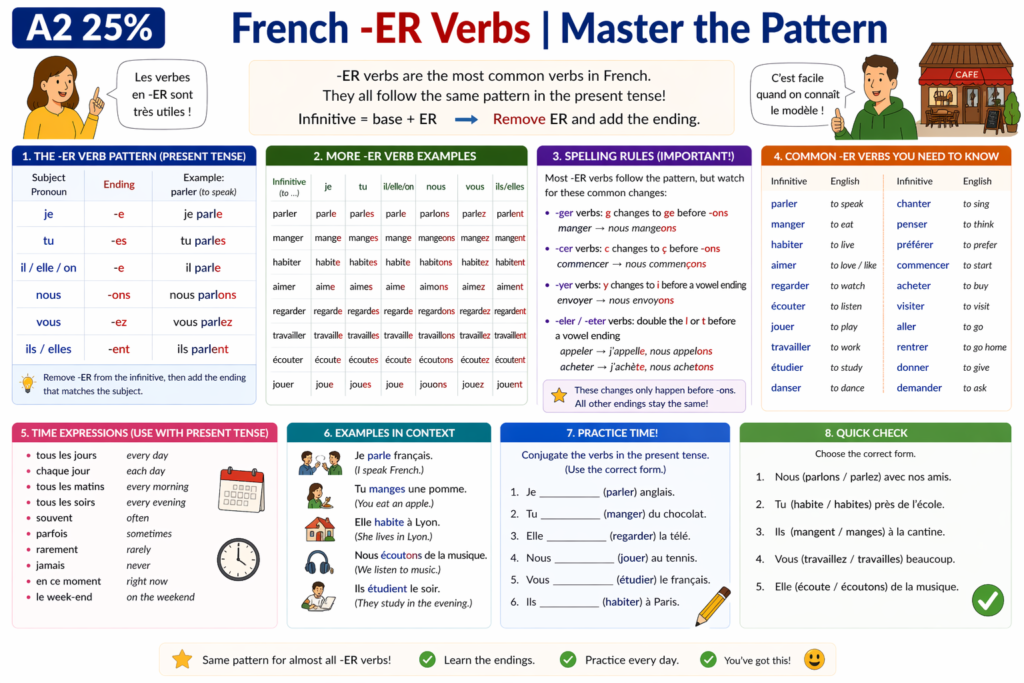
1. Conjugation Pattern (VERY IMPORTANT)
Step 1
Remove -er
- parler → parl-
- travailler → travaill-
Step 2
Add endings
- je → -e
- tu → -es
- il / elle → -e
- nous → -ons
- vous → -ez
- ils / elles → -ent
Example: travailler
- je travaille
- tu travailles
- il travaille
- nous travaillons
- vous travaillez
- ils travaillent
Same pattern for all regular -ER verbs.
2. Pronunciation Rules (CRUCIAL)
In French -ER verbs, many endings are silent.
Same Sound
- je travaille
- tu travailles
- ils travaillent
All sound the same
Different Sound
- nous travaillons
- vous travaillez
These are clearly pronounced
Key Insight
You hear the difference mainly in:
- nous
- vous
3. Spelling Matters at A2
Even if pronunciation is similar, spelling is different.
Examples
- je parle
- tu parles
- ils parlent
In writing (TEF), spelling is very important.
4. Common -ER Verbs You Must Know
To improve your French -ER verbs, practice with:
- parler → Je parle français
- aimer → J’aime le café
- habiter → J’habite à Mumbai
- travailler → Je travaille le matin
- étudier → J’étudie le soir
These verbs appear in almost every conversation.
5. Common Mistakes in French -ER Verbs
Errors
- Je parl
- Nous parle
- Ils parles
Correct Forms
- Je parle
- Nous parlons
- Ils parlent
Always check:
– ending
– subject
6. Special Cases (-GER and -CER verbs)
Some French -ER verbs change slightly.
Example: manger
- nous mangeons ✔️ (extra “e”)
Example: commencer
- nous commençons ✔️ (ç instead of c)
These changes help pronunciation.
7. Using -ER Verbs in Real Sentences
Structure
subject + verb + complement
Examples
- Je parle français
- Nous habitons à Delhi
- Ils travaillent le week-end
Add Details (A2 Level)
- Je travaille le matin
- Je travaille dans un bureau
Add Connectors
- Je travaille et j’étudie
- J’aime le sport, mais je suis fatigué
This is how you move to A2.
8. TEF Canada Strategy (Exam Focus)
In TEF Canada, French -ER verbs are used in:
- almost every sentence
- speaking and writing
- describing daily life
What the examiner checks
- correct endings
- correct subject agreement
- clear sentences
High-Scoring Example
- Je travaille dans un bureau
- J’habite à Mumbai
- Je parle français
Simple + correct = strong score
9. Practice (A2 Level)
Exercise 1
Conjugate:
- parler → nous ______
- aimer → ils ______
- travailler → je ______
Exercise 2
Correct:
- Nous parle
- Ils parles
Exercise 3
Write 3 sentences:
- one with parler
- one with aimer
- one with travailler
10. Mini TEF Speaking Task
Situation: Describe your daily life
Model Answer
Je travaille le matin.
J’étudie le soir.
Je regarde la télévision.
Continue Learning French
After mastering French -ER verbs, continue with:
- Learn essential irregular verbs (être, avoir, aller, faire)
- Practice French present tense (full sentences)
FAQ
What are French -ER verbs?
They are regular verbs ending in -er.
Why are they important?
They are the most common verbs in French.
Are endings pronounced?
Most endings are silent.
Is this important for TEF Canada?
Yes. They are used in almost every answer.
Final Tip
To master French -ER verbs, remember:
- same pattern for all verbs
- spelling matters
- pronunciation is often the same
This is your strongest grammar tool.