
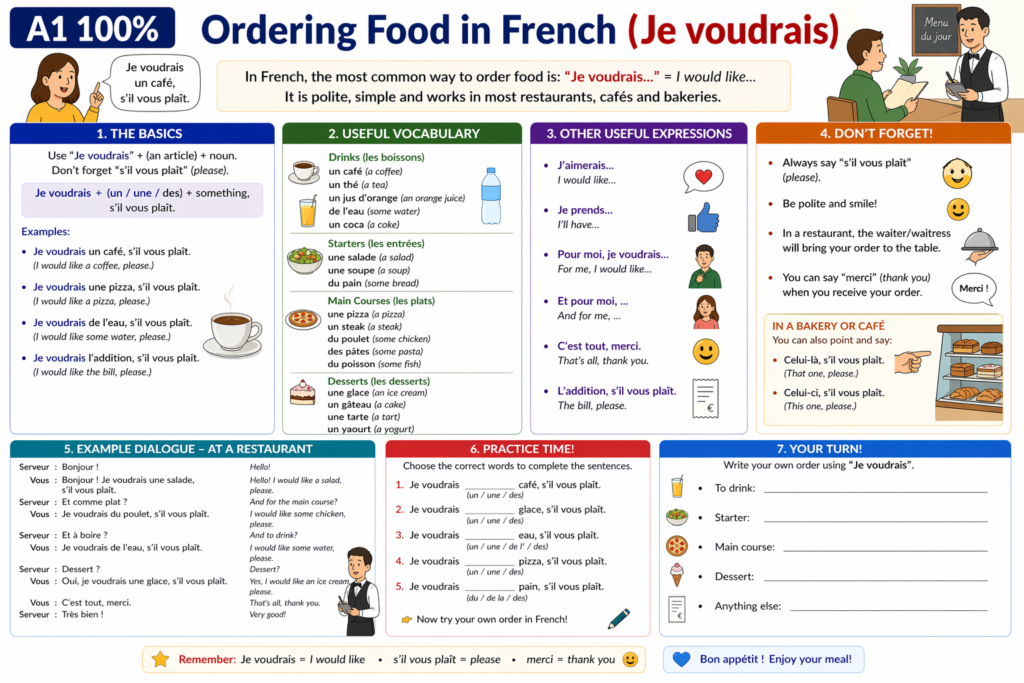
Description
Learn ordering food in French using “je voudrais” with polite grammar, partitive articles, and real TEF Canada examples for A1–A2 learners.
Introduction: How to Order Food Politely in French
In this lesson on ordering food in French, you will learn how to speak politely in real-life situations like restaurants and cafés.
At this stage (TEF 100%), you must:
- interact naturally
- use polite grammar
- communicate clearly
Mastering ordering food in French will help you:
- speak confidently in restaurants
- use correct structures
- succeed in TEF Canada speaking tasks
What Does “Ordering Food in French” Mean?
Ordering food in French is not just vocabulary.
It is based on:
- polite grammar
- correct verb forms
- appropriate expressions
Key Idea
In French, you do NOT say:
Je veux un café
You say:
Je voudrais un café
1. The Politeness Rule (VERY IMPORTANT)
In ordering food in French, politeness is essential.
Grammar Logic
- je veux → direct (can sound rude)
- je voudrais → polite
Why?
“Je voudrais” is the conditional form of vouloir.
It expresses:
- politeness
- respect
- softer intention
Examples
- Je voudrais un café
- Je voudrais de l’eau
- Je voudrais un sandwich
2. Structure of Ordering Food in French
Basic Structure
Je voudrais + food / drink
Examples
- Je voudrais du riz
- Je voudrais de la soupe
- Je voudrais des fruits
Notice: food uses partitive articles
3. “Pour moi” Structure (Very Natural)
In ordering food in French, you can also say:
Structure
Pour moi + noun
Examples
- Pour moi, le poulet
- Pour moi, une salade
Why Use It?
- very natural
- used in restaurants
- simple and effective
4. Add Politeness (Essential for TEF)
Always add:
- s’il vous plaît
- merci
Example
- Je voudrais un café, s’il vous plaît
- Je voudrais de l’eau, merci
This shows good communication skills
5. Using Partitive Articles (Food Grammar)
In ordering food in French, food is usually:
non-countable
So you use:
- du (masculine)
- de la (feminine)
- de l’ (vowel)
- des (plural)
Examples
- du riz
- de la soupe
- de l’eau
- des légumes
6. Common Mistakes in Ordering Food in French
Grammar Errors
- Je veux un café
- Je voudrais café
- Je prends ce
Correct Forms
- Je voudrais un café
- Je voudrais du café
- Je prends ça
Small mistakes can reduce your TEF score.
7. TEF Canada Strategy (Exam Focus)
In TEF Canada, ordering food in French tests:
- politeness
- grammar accuracy
- real-life communication
Example Situation
Vous êtes au restaurant.
High-Scoring Answer
- Bonjour
- Je voudrais un café, s’il vous plaît
- Pour moi, une salade
- Merci
Always:
- greet
- order
- be polite
8. Practice (A1 → A2 Progression)
Exercise 1
Complete:
- Je ___ un café (voudrais / veux)
- Je voudrais ___ eau (de l’ / le)
- Je voudrais ___ soupe (du / de la)
Exercise 2
Correct:
- Je veux un café
- Je voudrais café
Exercise 3 (A2 Level)
Write a full order:
- drink
- food
- polite ending
9. Mini TEF Speaking Task
Situation: You are at a restaurant.
Model Answer
Bonjour,
Je voudrais un café, s’il vous plaît.
Pour moi, une salade.
Merci.
Continue Learning French
After mastering ordering food in French, continue with:
- Learn French partitive articles (du, de la, de l’, des)
- Practice French quantities (beaucoup de, un peu de)
FAQ
How do you order food in French politely?
Use: Je voudrais + food + s’il vous plaît.
Why not say “je veux”?
Because it sounds too direct.
What articles do we use for food?
Partitive articles: du, de la, de l’, des.
Is this important for TEF Canada?
Yes. It is a real-life communication task.
Final Tip
To master ordering food in French, focus on:
- je voudrais (not je veux)
- correct articles
- polite expressions
This is exactly what examiners expect.