Description
Learn French modal verbs (vouloir, pouvoir, devoir) with simple rules and examples. Express ability, obligation, and desire for A1–A2 and TEF Canada.
Introduction: How to Use Modal Verbs in French
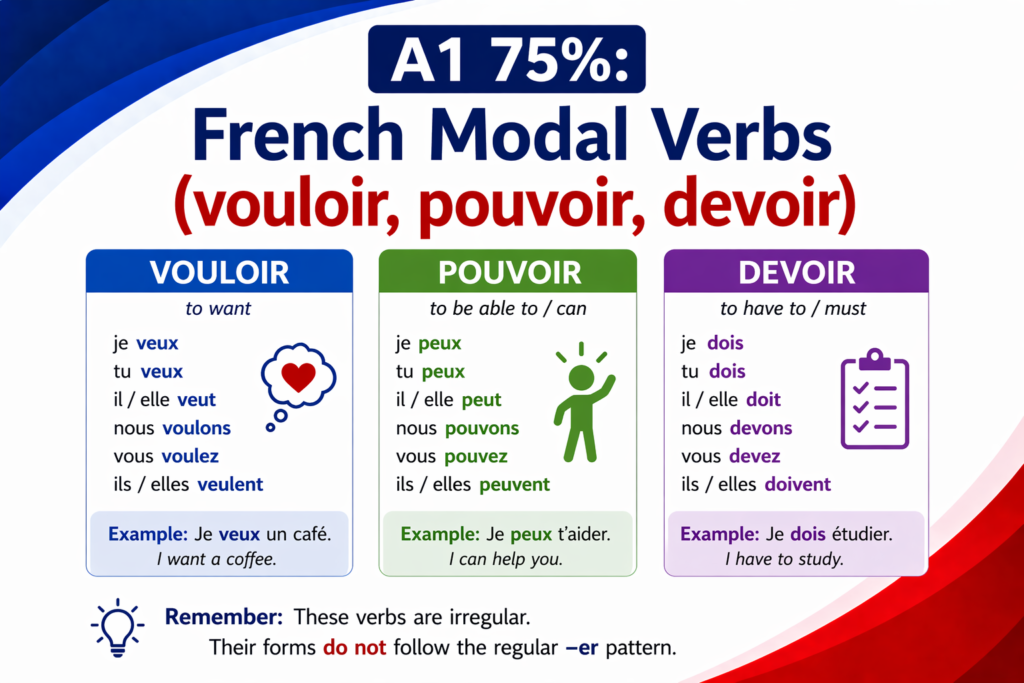
Today, you are going to learn French modal verbs (vouloir, pouvoir, devoir), a key grammar point for A1–A2 learners and TEF Canada.
If you want to:
- say what you want
- express what you can do
- explain what you must do
you must master French modal verbs.
This lesson will help you:
- understand vouloir, pouvoir, devoir
- use them in sentences
- build natural A1–A2 communication
- avoid common mistakes
1. What Are French Modal Verbs?
Modal verbs are used to express:
- desire → vouloir (to want)
- ability → pouvoir (can / may)
- obligation → devoir (must / have to)
2. Structure of Modal Verbs
Basic Structure
Subject + modal verb + infinitive
Examples
- Je veux déménager
- Je peux visiter l’appartement
- Je dois travailler demain
Important Rule
The second verb stays in the infinitive form.
3. Vouloir (to want)
Uses
- express desire
- make polite requests
Examples
- Je veux déménager
- Je veux visiter l’appartement
TEF Tip
For politeness, you can say:
- Je voudrais visiter l’appartement
4. Pouvoir (can / may)
Uses
- express ability
- ask for permission
Examples
- Je peux visiter l’appartement
- Nous pouvons sortir
5. Devoir (must / have to)
Uses
- express obligation
- talk about responsibilities
Examples
- Je dois travailler demain
- Tu dois étudier
6. Using Modal Verbs in Real Sentences
Examples
- Je veux visiter cet appartement
- Je peux venir demain
- Je dois travailler le matin
These sentences are very common in daily life.
7. Common Mistakes to Avoid
Avoid these errors:
- Je veux visite (incorrect)
- Je peux aller au cinéma hier (incorrect)
- Je dois à travailler (incorrect)
Correct forms:
- Je veux visiter (correct)
- Je peux aller au cinéma (correct)
- Je dois travailler (correct)
8. TEF Canada Strategy (Very Important)
In TEF Canada, French modal verbs are essential.
You use them to:
- express plans
- make requests
- explain obligations
High-Scoring Examples
- Je veux visiter l’appartement
- Je peux venir demain
- Je dois travailler le soir
Keep your sentences:
- simple
- correct
- natural
9. Practice Now (A1–A2 Level)
Complete with the correct verb:
- Je ___ visiter l’appartement (want)
- Tu ___ travailler demain (must)
- Nous ___ aller au cinéma (can)
10. Mini Speaking Task (TEF Style)
Answer:
Que voulez-vous faire ?
Model:
Je veux visiter un appartement.
Je peux venir demain.
Je dois travailler le matin.
Continue Learning French
Now that you understand French modal verbs, continue with:
FAQ
What are French modal verbs?
They are verbs like vouloir, pouvoir, devoir used to express desire, ability, and obligation.
How do you say “I want to go” in French?
Je veux aller.
Do you conjugate the second verb?
No. It stays in the infinitive.
Is this important for TEF Canada?
Yes. It is used in speaking and writing tasks.
Final Tip
If you master French modal verbs, you will:
- express ideas clearly
- communicate naturally
- improve your TEF Canada performance